Showing posts with label News. Show all posts

Sunday, May 3, 2026

Podcasts, Book Talks, and Reviews of A Chinese Reformer in Exile

New Books Network Interview with Robert L. Worden and Jane Leung Larson by Li-Ping Chen

Li-Ping Chen, a visiting scholar at the Department of East Asian Languages and Cultures, University of Southern California, led a substantive interview with Robert Worden and Jane Leung Larson on the East Asian Studies channel of the New Books Network, posted on October 10, 2025. The interview explores how this book came together, from its inception as Worden's B.A. thesis in the late 1960s to its final completion as a collaborative project with four co-authors, beginning in 2011 and ending with publication in 2025. Worden and Larson take the listener through the chapters of the book, the impact of new archival collections in developing the book's narrative. Chen learned about A Chinese Reformer in Exile from Zhongping Chen, a major contributor to this book, who was interviewed on New Books Network in 2024 about his related book, Transpacific Reform and Revolution

Northwest China Council and First Saturday PDX, at Reed College, Portland, Oregon: A Chinese Reformer in America with Jane Leung Larson

Saturday, March 7, 9:30 to 11:00 AM, Reed College

Jane Leung Larson returned to her alma mater (Reed, 1967) and the organization she founded in 1980 (Northwest China Council) to talk about Kang Youwei and the Chinese Empire Reform Association in North America. She was introduced by Jeffrey Kinkley, a Chinese literary historian and active in the Northwest China Council. Portland, Oregon was the lead chapter in the Northwest regional division of the United States Association, which had at least 23 chapters. Portland hosted a Western Military Academy school, a branch of Kang Tongbi's women's association, and a Mutual Defense Division (Lianweibu 聯衞部). She explored how Kang mobilized overseas Chinese communities such as Portland to support a constitutional monarchy, modern education, and political reform in China and highlighted the global dimensions of the reform movement and its impact on overseas Chinese communities. A PDF of the PowerPoint presentation with notes, including sources of images and links to relevant chapters of A Chinese Reformer in Exile is available here

UCLA East Asian Library Book Talk with Jane Leung Larson

December 4, 2025, 1:00 to 2:30 PM, Charles E. Young Research Library, Presentation Room 11348

Jane Leung Larson introduced A Chinese Reformer in Exile and how the Tom Leung papers expanded our knowledge of Kang Youwei's travels and activities in the United States. The UCLA Asian Library holds the papers, which were donated by Louise Leung Larson in the 1980s. UCLA China historian Andrea Goldman will comment on how she has used the papers as a teaching tool. A PDF of the PowerPoint presentation with links to the book and to the UCLA documents described can be downloaded here.

MOCA TALKS – A Chinese Reformer in Exile: Kang Youwei and the Chinese Empire Reform Association in North America with Robert L. Worden and Jane Leung Larson

October 30, 2025, 7 PM, Museum of Chinese in America, 215 Centre St., New York City

Robert Worden and Jane Leung Larson are in conversation with Evans Chan, whose films and opera on Kang Youwei brought them together to write A Chinese Reformer in Exile. The YouTube podcast is here

Thursday, October 23, 2025

"A Chinese Reformer in Exile" Published by Brill as Open Access Book

A Chinese Reformer in Exile: Kang Youwei and the Chinese Empire Reform Association in North America, 1899-1911 

By Robert L. Worden and Jane Leung Larson, with Zhongping Chen, Evelyn Hu-DeHart, Chen Xuezhang, and Yang Zheng 

Brill (Leiden), 2025

https://brill.com/display/title/70307

Open Access PDF:

https://brill.com/downloadpdf/display/title/70307.pdf


This complex, transnational history was made possible by . . . 

A team of scholars with different perspectives and areas of expertise.

Outside collaboration with local historians, specialists on topics as diverse as trolley lines in Mexico and Chinese currency, descendants of Kang and Baohuanghui members, and those who interacted with this blog, Baohuanghui Scholarship.

A wide variety of primary sources:

       Government records, Chinese and foreign language newspaper coverage.

       Personal correspondence, diaries, poems, publications by Kang and others.

       Baohuanghui records and ephemera, from menus to membership buttons.

Friday, August 30, 2024

Recent Books on Kang Youwei and the Baohuanghui

A number of notable books in English about Kang Youwei and/or the Baohuanghui have been published in recent years. Given the transnational scope of Kang's life and political organization, his wide-ranging creative endeavors and intellectual output, the range of book topics is not surprising. Kang's concerns and the Baohuanghui's impact on Chinese lives and political aspirations, both in China and overseas, resonate today. 

For each book, there is a link to an Open Access excerpt, book review, or online podcast or book talk. 

The Baohuanghui

Transpacific Reform and Revolution: The Chinese in North America, 1898−1918 by Zhongping Chen (Stanford: Stanford University Press, 2023). Transpacific Reform and Revolution: A Conversation with Zhongping Chen is an interview article by Elisabeth Forster, Made in China Journal: "Zhongping Chen traces the networks in which reformers around Kang Youwei and revolutionaries around Sun Yat-sen operated. Chen focuses mostly on Canada and the United States. . . This is a fascinating study that shows Chinese reformers and revolutionaries of the period in an entirely new, much more pragmatic light. Chen discusses the status Kang and Sun had in their networks and the way these networks operated—from business activities and funding through membership fees, to the lawsuits they levelled against each other, and even assassinations." A recorded interview by Li-Ping Chen with Zhongping Chen is on the New Books Network

Wednesday, April 4, 2018

Research on Kang Youwei and the Baohuanghui in North America: Sources and Methods


Kang Youwei in Los Angeles, 1905
Private collection, Jane Leung Larson
In March 2018, Chinese scholars specializing in Kang Youwei convened in Kang’s birthplace, Nanhai, Guangdong, to commemorate the 160th anniversary of his birth and 120th anniversary of the 1898 Hundred Days of Reform. Those of us coming from North America focused on Kang’s experience in the New World from 1899 to 1909. In particular, we made use of the source materials from South Windsor, Connecticut and Los Angeles that have illuminated our knowledge of Kang’s activities in Canada, the United States and Mexico. 

Jane Leung Larson spoke on “Research on Kang Youwei and the Baohuanghui in North America: Sources and Methods.”  She contrasted the relatively open access to resources on Kang and the Baohuanghui in North American archives, libraries, and the internet with the much more restrictive research environment in which Chinese historians work.

Wednesday, July 19, 2017

Charter 08's Qing Dynasty Precursor

This article is re-published to salute the life and work of Chinese political reformer Liu Xiaobo. Liu died in custody on July 13, 2017 at age 61, effectively executed by his government as he languished in prison with untreated liver cancer. Inside China, few have heard of Liu, who was imprisoned for his involvement in the Charter 08 petition movement calling for constitutional and political reform. Sadly, the world also abandoned Liu even after he won the Nobel Peace Prize in 2010. 

Published in July 2011, "Charter 08's Qing Dynasty Precursor," by Jane Leung Larson with commentary by Chinese Australian scholar Feng Chongyi (who was himself detained on his last visit to China) first appeared in Asia Pacific Journal. The article contends that Kang Youwei's 1908 constitutional petition is a forerunner of Charter 08, comparable not only as a comprehensive program to reform China's autocracy but for how the Chinese government responded. The article opens:
Over the gulf of one century and two revolutions, two groups of Chinese petitioners drafted remarkably similar blueprints for political reform. Both groups sought civil rights and political responsibilities for Chinese citizens and a Western-influenced form of constitutional government to replace rule by autocracy. Today, China’s autocratic government is ruled by the Chinese Communist Party, and in the waning years of the Chinese empire, it was ruled by the Qing dynasty. The striking differences between these petition movements are as instructive as their similarities, reflecting not only the qualities of the movements themselves but the radically different political environments—inside and outside China—from which they emerged.

In 2008, Charter 08 declared that “freedom, equality, and human rights are universal values of humankind, and democracy and constitutional government are the fundamental framework for protecting these values.”[1] Charter 08’s drafters, of whom the 2010 Nobel Peace Prize winner Liu Xiaobo is the most prominent, describe themselves as inheriting China’s historical legacy of political reform. They called for a citizens’ movement “so that we can bring to reality the goals and ideals our people have incessantly been seeking for more than a hundred years.” They credit the 1898 Hundred Days of Reform led by the Guangxu Emperor to transform China into a constitutional monarchy with being China’s “first attempt at modern political change,” and the first sentence of their petition reads, “A hundred years have passed since the writing of China‘s first constitution.” 


Indeed, this decade, 1898 to 1908, foreshadowed what has been more than a century-long sporadic, often marginal, and as yet unfulfilled movement to eliminate China’s autocratic system and give Chinese people the right to take part in national affairs. As Charter 08 acerbically notes, with “the revolution of 1911, which inaugurated Asia’s first republic, the authoritarian imperial system that had lasted for centuries was finally supposed to have been laid to rest.” All too soon, “the new republic became a fleeting dream.” And, finally, “the ’new China’ that emerged in 1949 proclaimed that ‘the people are sovereign’ but in fact set up a system in which ‘the Party is all-powerful’. . . . Unfortunately, we stand today as the only country among the major nations that remains mired in authoritarian politics.


[1]China’s Charter 08,” translated from the Chinese by Perry Link, New York Review of Books, January 15, 2009https://rsf.org/sites/default/files/Charter08.pdf

Sunday, May 1, 2016

Boise, Idaho Signboard for the Imperial Constitutional Association

Signboard from Baohuanghui
Building, Boise, Idaho
Courtesy of Asian American
Comparative Collection,
University of Idaho,
AACC-2015-20.
This is the only extant example of a Chinese Empire Reform Association (CERA) signboard. It comes from a CERA building that was constructed after Kang Youwei visited Boise, Idaho from October 18 to 25, 1905. We do not know when this building at Seventh and Front Street was completed, but  on February 26, 1907, the local reform association led a parade with a 20-man dragon that ended at this address ("Chinese Lion to Protect Joss," Idaho Statesman, February 21, 1907). The CERA building was one of several new Baohuanghui buildings erected beginning in 1905 in Victoria, BC and Los Angeles, among other places. The Boise brick and stone building was to cost about $3,000 to build, with two stories (ground level for retail use, the second floor for the CERA meeting hall) ("Chinamen Plan $3000 Building," Idaho Statesman, November 14, 1905).

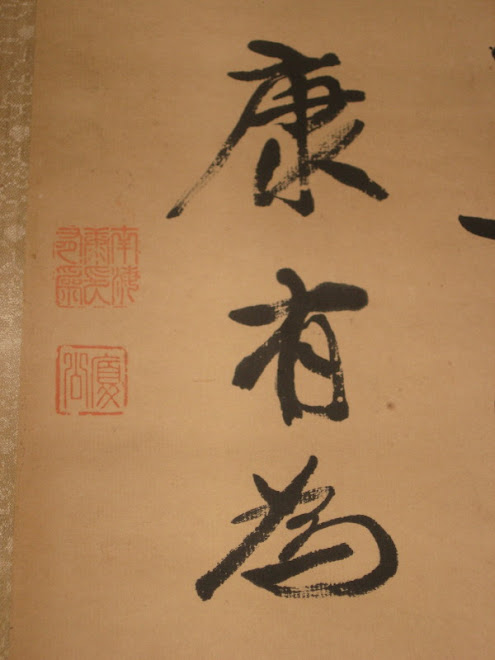
Seals "Kang Youwei yin" and "Gengsheng."
Courtesy of Asian American Comparative Collection,
University of Idaho, AACC-2015-20.


"Diguo Xianzhenghui" or Imperial Constitutional Association is carved and painted on the wood signboard. On the left are two seals, the top reading "Kang Youwei yin" (the seal of Kang Youwei) and the bottom " "Gengsheng" ("born again"--Kang Youwei's nickname during his exile). Because Kang changed the name of CERA in Chinese from Baohuanghui, or Protect the Emperor Association, to Xianzhenghui on the lunar new year (February 13, 1907), we know the sign dates from 1907 or later.

Friday, February 6, 2015

A Chinese Reformer in Exile: Kang Youwei and the Chinese Empire Reform Association in North America, 1899-1909


A book in progress . . . 
By Robert L. Worden (Library of Congress, ret.) and Jane Leung Larson (independent scholar) With Zhongping Chen (University of Victoria), Chen Xuezhang (independent scholar, Guangzhou), and Evelyn Hu-DeHart (Brown University)

A Chinese Reformer in Exile will be a narrative history of the North American decade (1899 1909) of the radical Qing reformer, Kang Youwei, and his political movement. 

Our book will fill a critical gap in late Qing political history and in the biography of China’s most famous reformer. This will be the first book in English devoted to Kang’s exile and transnational political organization, the Baohuanghui or Chinese Empire Reform Association (CERA). Traversing the United States, Canada, Mexico, and China, this will become an authoritative reference for historians of the Chinese diaspora as well as political scientists studying Chinese dissidents, Chinese political organizations, and the development of Chinese liberalism.

We demonstrate that Kang’s fifteen years in exile—especially the decade spanning his visits to North America—were the most productive in his life. Kang embraced a new persona as politician, statesman, business speculator, and inveterate traveler, while assiduously adding to his already voluminous written legacy of books, essays, letters, and poems. North America inspired Kang’s transformation from a utopian philosopher into a more practical visionary consumed with the material world, which he now believed was the means of national salvation for China.

Friday, November 14, 2014

The Kang Tongbi Collection of South Windsor, Connecticut--New England AAS Presentation


American academics previewed the newly-discovered South Windsor collection of Kang Youwei and Baohuanghui documents at the New England conference of the Association of Asian Studies on October 4, 2014. 

Linked here is Jane Leung Larson's PowerPoint presentation with speaker notes. A more detailed exploration of the collection is in Larson's paper. In March 2016, Larson revised her paper and presentation for a panel on transnational Chinese political feminism organized by Zhongping Chen at the national Association of Asian Studies in Seattle, These are the documents linked to above.